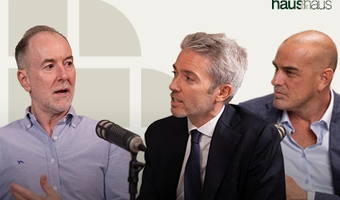
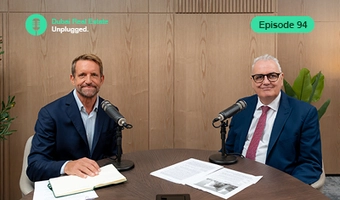
In this episode of Dubai Real Estate Unplugged, Paul Sharland and Steven Leckie reflect on two decades of Dubai's remarkable transformation.
From their first meeting in 2005 to today’s booming market, they share first-hand insights into how Dubai evolved from an experimental property market into a global real estate powerhouse.
Key takeaways
- Dubai's population grew from 1.2 million in 2005 to 3.9 million in 2025, with international schools increasing from 17 to 230.
- Early investors were speculative buyers flipping properties, whilst today's buyers are families planning to relocate and live in Dubai long term.
- Palm Jumeirah garden homes sold for 2.5 million dirhams in 2005 and now trade around 30 million dirhams.
- Dubai is recognised as a top five global city but remains outside the top 50 for price per square metre, offering exceptional value.
- Infrastructure improvements, including roads, schools, healthcare and entertainment options, have transformed Dubai's livability dramatically.
From unknown destination to global property hub
When Paul arrived in Dubai in April 2005, the city was still relatively unknown to international investors. The working week ran Thursday to Sunday, there was no Google Maps to navigate the sparse road network, and areas like Jumeirah Lake Towers had no traffic lights or proper signage.
"When we came here, the population was 1.2 million," Paul recalls. "Fast forward 20 years, the population now is 3.9 million and growing." This dramatic population increase reflects Dubai's evolution from regional business centre to globally recognised metropolis.
Steven adds that Dubai’s reputation has changed entirely, shifting from a niche market to a globally recognised city.
The city's social infrastructure grew exponentially alongside its population. International schools increased from 17 to 230, entertainment venues expanded from a handful of popular spots to thousands of options, and the weekend shifted from Thursday and Friday to Friday and Saturday to align with global business practices.
The early days: speculation and experimentation
Both Paul and Steven remember when Dubai's real estate market was considered highly speculative. Early buyers were taking calculated risks, similar to investors who had purchased in Marbella or Bulgaria during previous property booms.
"Dubai was an experiment at the beginning," Paul explains. "The Palm, the Marina, it was an experiment. Will this work? Now obviously what we know 20 years later is it's worked extremely well."
A significant concern for early buyers was property ownership security. Steven recalls conversations about whether freehold purchases were truly permanent. "People were saying, 'If I buy a freehold villa on a freehold plot, what's to stop one of the locals saying, Well, I want that plot. They could just take it away from you.' There was that nervousness."
Sheikh Mohammed spent years establishing Dubai Land Department regulations and legal frameworks to provide investor confidence. These efforts created the foundation for Dubai's transformation from speculative market to stable, long-term investment destination.
Palm Jumeirah: where it all began
Palm Jumeirah represented Dubai's ambition and became the catalyst for the city's property boom. Garden homes and signature villas sold directly from Nakheel for approximately 2.5 million dirhams, equivalent to 500 dirhams per square foot.
Buyers were flipping properties immediately, sometimes selling the next day or week for substantial premiums. This created a feeding frenzy as investors with smaller budgets purchased one-bedroom apartments in Dubai Marina or other developments, hoping to replicate the Palm's success.
"Over 50% of the first 100 British passport holders who bought in Palm Jumeirah had a Marbella address," Paul reveals. "They were either living in Marbella or they'd invested in Marbella and they saw Dubai as the next opportunity to make money."
Today, those same garden homes that sold for 2.5 million dirhams trade at around 30 million dirhams, underlining the scale of Dubai’s long-term capital growth.
Dubai Marina and infrastructure lessons
Dubai Marina emerged quickly as a major waterfront development, but the rapid construction created infrastructure challenges. Roads and parking weren't properly planned, creating congestion issues that persist today.
However, Paul and Steven emphasise that Dubai learns from mistakes. "This is just more proof that we've been saying for the last 20 years, Dubai learns from its mistakes. It doesn't make the same mistakes twice. It's always looking to improve."
Downtown Dubai incorporated underground parking to address Marina's parking problems. Dubai Creek Harbour combined the best elements of Marina's waterfront appeal with Downtown's infrastructure planning, creating an improved master community.
This continuous improvement philosophy extends across all aspects of city development, from road networks to community facilities and public services.
From flippers to families: the buyer evolution
The most significant change Paul and Steven observe is the shift in buyer profiles and motivations. In 2005, the typical buyer was a speculative investor with no intention of living in Dubai, focused purely on short-term capital appreciation.
"Back in the day, it was all about buying to flip," Steven explains. "Now it's people are buying to live here and move here."
Today's buyers take five to ten-year investment horizons rather than two to three-year flips. They're families researching international schools, professionals seeking career opportunities, and retirees attracted by healthcare quality and lifestyle amenities.
Europeans, North Americans and Canadians now constitute major buyer segments, whereas South Asian investors dominated early markets due to existing familiarity with Dubai as a stopover destination.
"The investors I'm talking to now, some are actually talking about moving here," Paul notes. "They're not taking a two to three-year view. They're taking a minimum five-year view, more like 10 years."
Why Dubai remains exceptional value
Despite recognition as a top five global city, Dubai doesn't rank in the top 50 cities by price per square metre. This puzzles both Paul and Steven, who see this as evidence of exceptional value rather than market weakness.
"If anybody would like to work that out for us, please let us know," Paul jokes. "We don't have an answer to that."
Steven suggests this reflects Dubai's status as a developing country but predicts eventual elevation into global property price rankings. "What that suggests to me is that it will be in the top five, top 10 eventually. Maybe not in the next 5 or 10 years, but at some point in the future, it must be one of the more expensive places in the world to live."
A brand new one-bedroom apartment in Jumeirah Village Circle costs approximately 1.2 to 2 million dirhams (£250,000 to £300,000), including fitted kitchen, infinity pool and gymnasium facilities. Comparable properties in London, Paris or New York would cost at least £1 million.
"When everyone says it's expensive, what is expensive apart from your food?" Paul asks. "Your petrol's for nothing anyway. You can have your six-litre car here."
Jumeirah Village Circle: community success story
Jumeirah Village Circle exemplifies Dubai's ability to create affordable, desirable communities. Despite criticism from some market commentators, JVC has developed strong community appeal, particularly among young professionals and families.
"People live in JVC because they like the environment. They like the parks. They like the shopping centre. They like the community," Steven emphasises.
Paul's sons and their friends have lived in JVC, providing firsthand evidence of its social cohesion. The Circle Mall, quality gymnasiums, hotels and weekend social gatherings create genuine community spirit.
Ongoing infrastructure investments, including major road improvements, address historical traffic concerns. "Over the next couple of years, it is going to get better," Steven predicts with confidence.
The construction traffic that currently impacts JVC roads serves a purpose. "You don't want to put a brand new road in when there's a big 15-ton truck going through with loads of rubble and building materials," Steven notes logically.
Education, healthcare and quality of life
Dubai's transformation extends far beyond property development. The education sector expanded dramatically, attracting prestigious international schools including Harrow, Dulwich College and Repton alongside strong mid-tier options and schools serving diverse nationalities.
"We don't know the names or which are the top schools for other countries, but we know like Indian schools, Iranian, American, Canadian, there's French, Swiss," Paul observes. This diversity reflects Dubai's multicultural population.
Universities and higher education institutions increasingly establish Dubai campuses, reducing the need for students to study abroad. Paul notes that whilst three out of ten students returned to Dubai after university historically, nine out of ten now return.
Healthcare quality has improved substantially, attracting UK-trained and North American-trained doctors drawn by superior equipment, reasonable working hours and professional satisfaction.
"When I turn up to a hospital to have a checkup and you make your appointment at 10:15, you get to see the doctor at 10:15," Paul explains. "It's like checking into a hotel."
Employment opportunities across generations
Dubai's job market has matured significantly, providing opportunities for young professionals and experienced workers alike. Paul's sons, aged 26 and 29, recently changed jobs and each received four to five job offers despite initial concerns.
"If that was 10 or 15 years ago, if they'd lost their job, they'd be looking at going back to the UK," Paul reflects. "If someone loses their job here or someone sees an opportunity here, if you're a startup or if you just flow over here and think, 'Right, I'm looking for something to do,' there is a job out there for you."
This employment security extends to retirees and semi-retirees, with both Paul and Steven expressing confidence about working well into their seventies in Dubai's dynamic environment.
Dubai's safe haven status
Dubai's political neutrality provides stability attractive to international investors during uncertain global times. The UAE maintains positive relationships with all major powers, similar to Switzerland's historical role.
"The politics, the UAE has always been neutral and will always remain neutral," Steven explains. "So whoever side you're on, whether it's the Russians, the Chinese, the Iranians, the Americans, the Europeans, they all need the UAE."
This neutrality, combined with zero income tax, inheritance tax and capital gains tax, positions Dubai as the "safest safe haven in the world" according to Paul.
European and North American buyers increasingly cite safety, education quality and future opportunities as primary motivations for relocating to Dubai, often expressing concerns about conditions in their home countries.
Looking forward: optimism after 20 years
After two decades in Dubai's real estate market, both Paul and Steven maintain genuine enthusiasm for the city's future. This isn't manufactured optimism but authentic excitement based on witnessing sustained transformation.
"Isn't it amazing though that us two after 20 years, we can still get excited about Dubai, but it's real excitement," Paul marvels. "We wake up excited because we know what's going on and we know what the future holds."
Their optimism reflects broader trends. A former colleague who worked with them from 2005 to 2008, subsequently spent 12 to 14 years in the UK and is now relocating back to Dubai with his family.
"He sees their future in Dubai, not in the UK," Steven concludes. "That just sums up what is going on in Dubai."