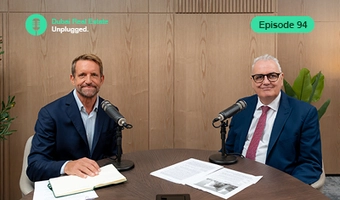
In this episode of Dubai Real Estate Unplugged, Charlie Bannan, Managing Director at haus & haus, is joined by Clementine, Paul Sharland and Jake Walton to unpack Q1 2025, a quarter defined by rapid growth, high confidence and strong returns. Together, they explore the Dubai real estate market trend, share practical real estate insights and discuss how buyers and investors can position themselves for the months ahead.
Key takeaways
- Q1 2025 confirmed Dubai’s sustained real estate market trend toward growth and long term stability.
- Off Plan demand, population growth and migration continue to support steady real estate yields.
- Market maturity signals healthy stabilisation rather than slowdown.
- Value remains accessible in emerging communities like Dubai South, Tilal Al Ghaf and Al Furjan.
Dubai’s real estate market in Q1 2025: confidence continues
Dubai’s property sector achieved one of its strongest quarters on record, with 27 % year-on-year growth in total transaction value, reaching AED 154 billion.
Paul notes that the data reflects enduring confidence rather than speculation: every global event, from Western elections to economic instability in Europe, seems to push more buyers toward Dubai’s stability and tax efficiency.
Clementine adds that while some observers predict a slowdown, buyer demand remains sustained across both Off Plan and secondary markets. “It’s not wishful thinking,” she explains. “People aren’t just talking about moving; they’re actually doing it.”
Off Plan momentum and global buyer demand
The episode highlights a 24.6% increase in Off Plan transactions for Q1, totalling more than AED 53 billion.
Paul attributes this to a new wave of European investors seeking financial security and lifestyle value. As defence spending and taxation rise in their home countries, Dubai’s real estate market trends increasingly appeal to those prioritising stability, transparency and ROI potential.
“It’s not about what’s happening in Dubai’s economy; it’s about who’s moving here,” Paul explains. “Population growth alone keeps prices resilient.”
Value still drives decision-making
Clementine points to price gaps that reveal how Dubai still offers global value.
For example, Al Furjan averages around AED 1,400 per sq.ft (≈ £300), compared with over AED 2,400 per sq.ft in Emirates Living.
She emphasises that communities like Al Furjan, Tilal Al Ghaf and Dubai South continue to offer exceptional entry points for mid-to-long term buyers, proof that real estate trends are increasingly driven by lifestyle and infrastructure, not just postcode prestige.
Rental market stabilisation and strong yields
Jake Walton reports a city-wide gross yield of 7.41 % on new contracts, a level that remains robust on a global scale.
While rental transaction volume dipped slightly (– 11.7 %), this reflects tenants transitioning into ownership and limited new supply rather than weakening demand.
“If you can recover your investment in under 14 years, that’s a healthy return,” Jake notes.
Landlords, he adds, must now compete with new developments offering superior facilities. Upgrading and maintaining existing homes is essential for protecting real estate yields.
Commercial growth and market maturity
Dubai’s commercial property segment saw 30.7% year-on-year growth, led by business expansion across Dubai South and new mixed-use hubs.
Paul contextualises this shift as part of a maturing cycle. Unlike 2008, today’s market is sustained by end-user demand, long term investors and a population approaching four million .
“A brief plateau isn’t a crash,” he says. “It’s the sign of a healthy, evolving market.”
This marks a critical stage in the Dubai real estate market trend, where price stability indicates maturity rather than volatility.
Expert advice for buyers and sellers
Clementine advises clients to work with exclusive agents who truly understand community pricing and negotiation dynamics.
Exclusive representation, she explains, prevents over-competition and protects both buyer and seller interests.
She also recommends using verified platforms such as Bayut’s TruBroker system to identify top-performing agents based on real data; a key takeaway for anyone seeking reliable real estate insights.